
Storm season is here. The Met Office has already named Storm Austen and Storm Boelo this autumn, and winter storms are the most common cause of long power cuts in the UK. A few simple jobs before the wind picks up can save you a cold, dark night, a defrosted freezer, or worse.
This guide covers what the warnings mean, what to do before, during and after a storm, and the kit worth having ready.
Buttons on this page go to Amazon. If you buy through them we may earn a small commission, at no extra cost to you. Review counts and star ratings are from Amazon UK when we checked in November 2026.
What do the Met Office warnings mean?
| Warning | What it means | What to do |
|---|---|---|
| Yellow | Some impacts are possible, such as travel delays | Check the forecast and think about whether you could be affected |
| Amber | Impacts are more likely and could disrupt your plans | Think about changing plans and take action to protect yourself and your property |
| Red | Dangerous weather is expected | Act now, avoid travelling and follow advice from the emergency services |
Storms are usually given a name when an amber or red warning is likely. You can check the latest warnings on the Met Office website or app.
Before the storm: your checklist
Outside
- Bring in or tie down anything loose: bins, garden furniture, plant pots and toys.
- Turn trampolines upside down or peg them down, and lock shed and garage doors.
- Park away from trees and fences if you can.
- Clear gutters and drains so heavy rain can get away.
Inside
- Charge everything: phones, power banks, laptops and any portable power station.
- Find your torches and lanterns and check the batteries. Battery lights are much safer than candles.
- Fill a flask with hot water, and fill a few bottles or containers with drinking water.
- Turn the fridge and freezer to their coldest setting a few hours before, and keep the doors shut.
- Get your emergency kit out where you can find it in the dark. See our 72-hour emergency kit checklist.
- Save 105 in your phone. It’s the free number for reporting and tracking power cuts across Great Britain.
Look out for others
- Join the Priority Services Register with your energy supplier and network operator if anyone in your home is elderly, disabled, has a medical condition, uses medical equipment or has young children. It’s free, and you’ll get extra help in a power cut.
- Check on older neighbours and relatives before the storm arrives.
During the storm
- Stay indoors as much as you can, and avoid walking or sheltering near buildings and trees.
- Don’t travel in a red warning unless you have to. If you must drive, slow down and give high-sided vehicles, cyclists and motorcyclists extra room.
- Keep away from the coast. Large waves can knock you off your feet, even from the promenade.
- If the power goes off, call 105 or check your network operator’s power cut map.
- Keep the fridge and freezer shut. A fridge keeps food safe for up to about four hours, and a full freezer keeps food frozen for up to about 48 hours, according to food safety guidance.
- Never use a camping stove, barbecue or petrol generator indoors. They give off carbon monoxide, which can kill. See our camping stove safety guide.
- Keep warm safely. Most gas central heating stops in a power cut. Our guide to keeping warm in a power cut has the simple things that work.
After the storm
- Stay well away from fallen power lines. Always treat them as live: UK Power Networks advises staying at least 10 metres away. Call 105 straight away, or 999 if someone is in danger.
- Don’t touch anything a cable is touching, such as a fence, a car or a tree.
- Check your food. If the fridge has been off for more than about four hours and is above 8°C, use chilled food quickly or throw it away. If in doubt, throw it out.
- Take photos of any damage before you start clearing up, for your insurer.
- Ask about compensation. If your power was off for a long time, your network operator may owe you a payment under the Guaranteed Standards. Ask when you call 105.
The storm kit worth having
You don’t need much, and most of it lasts for years. These are the things we’d have ready before winter.
A good lantern
A lantern lights a whole room, so it’s far more useful than a torch in a long power cut. This rechargeable LE lantern is one of the best-reviewed on Amazon UK, with over 30,000 reviews averaging 4.6 stars. For more options, see our best torches and lanterns for a power cut.
A head torch
Keeps your hands free for going out to the meter, checking the garden or cooking. This rechargeable Blukar pair averages 4.7 stars from over 14,000 reviews.
A power bank
Your phone is your torch, your news and your way to call 105. A 20,000mAh power bank gives most phones three or four full charges. See our best power banks for power cuts.
A wind-up or battery radio
If the mobile network goes down too, a radio is how you’ll hear local news. See our best wind-up radios.
A carbon monoxide alarm
Essential if you have a wood burner or any gas appliance, and cheap enough to fit in every home.
A portable power station (for longer cuts)
If you live somewhere that loses power for hours or days in a storm, a portable power station can keep the fridge-freezer, Wi-Fi, lights and phones going, safely indoors. A 1kWh model like the EcoFlow DELTA 3 Plus runs a typical fridge-freezer for well over half a day. See can a power station run a fridge-freezer? for the details. See our guide to the best power station for power cuts, or use our size calculator.
Frequently asked questions
Who do I call in a power cut?
Call 105 from a landline or mobile. It’s free and puts you through to your local network operator, who can tell you when the power should be back.
How long will my freezer stay frozen in a power cut?
Up to about 48 hours if it’s full, or around 24 hours if it’s half full, as long as you keep the door shut.
What should I do if I see a fallen power line?
Stay well away, at least 10 metres, and treat it as live. Call 105 straight away, or 999 if someone is in danger.
Do I get compensation for a long power cut?
Often, yes. Under the Guaranteed Standards, network operators have to pay compensation if your power is off for longer than set times. Ask your network operator by calling 105.
FREE PRINTABLE
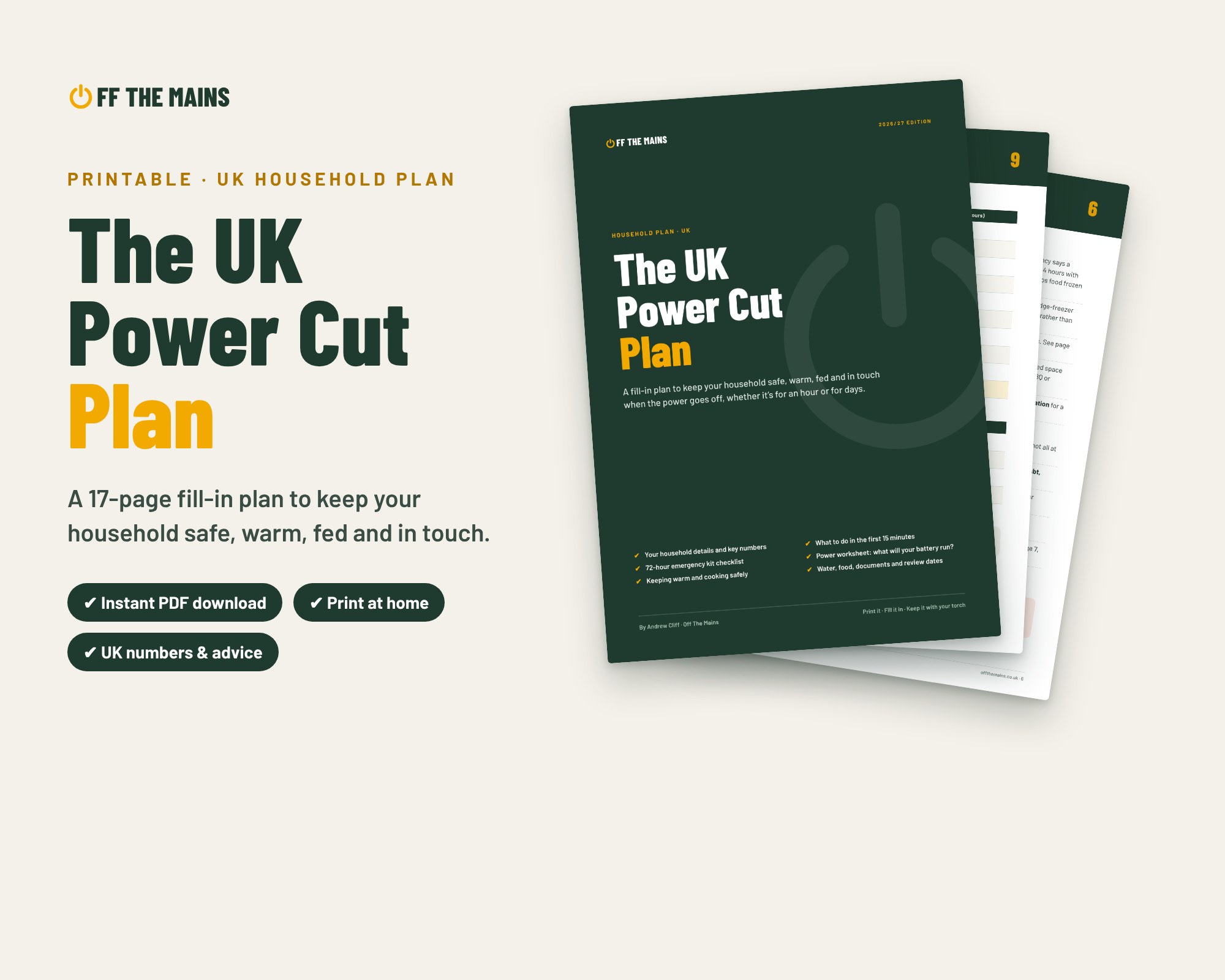
PRINTABLE PLAN
Get it all on paper: the UK Power Cut Plan
A 17-page fill-in plan with key numbers, a first-15-minutes action card, kit checklist and power worksheet. Instant PDF £4.99, or a full-colour paperback £9.99.
See what’s insideOr get the paperback on Amazon →
Written by Andrew Cliff, founder of Off The Mains
Andrew spent more than ten years running an agricultural machinery and parts business in Cheshire, where he learned to look past the brochure: what a machine is really rated for, what it costs to run and who it actually suits. He brings the same approach to off-grid power.
How we choose products · How we make money · Spotted a mistake?