
We may earn a commission if you buy through links on this page, at no extra cost to you. How we make money.
Quick answer: you have three realistic ways to power a garden office. The most reliable is a proper mains supply run by a registered electrician, which typically costs £800 to £1,500 for a basic setup. The cheapest and quickest is a 1kWh portable power station charged in the house, which will run a laptop, monitor and lights for a full working day. The third is solar panels plus a power station, which can run you through most of the summer but won’t keep up in a British winter.
Prices are approximate UK prices (RRP or typical retailer price) when we checked in November 2026. They change often, so use the buttons to see today’s price.
The one thing none of the off-grid options can do is run a normal electric heater. More on that below.
How much power does a garden office actually use?
Before you choose, work out your daily energy. For a typical laptop-based day it looks like this:
| What | Power | Hours | Energy per day |
|---|---|---|---|
| Laptop | 60W | 8 | 480Wh |
| External monitor | 25W | 8 | 200Wh |
| Wi-Fi extender or mesh unit | 10W | 8 | 80Wh |
| LED lighting | 10W | 4 | 40Wh |
| Phone charging | 2 charges | 15Wh | |
| Total | About 815Wh |
These are typical figures, so check the labels on your own kit. A desktop PC, a second monitor or a printer will push the total up.
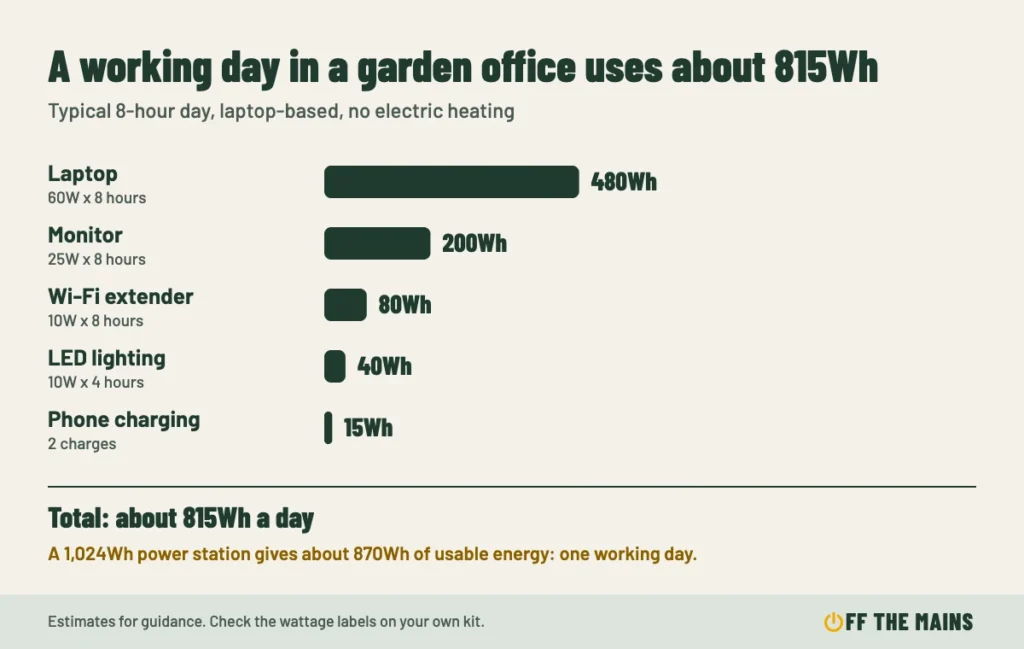
What that means: a 1,024Wh power station gives about 870Wh of usable energy once conversion losses are taken into account. That’s one full working day for a laptop-based office, with a little to spare.
The heating problem
This is where off-grid garden offices come unstuck. A typical electric fan heater or oil-filled radiator draws 1,000W to 3,000W. A 2,000W heater would empty a 1kWh power station in about 25 minutes, and many portable units can’t supply that much power at all.
If you want electric heating, you need a mains supply. Off-grid, focus on keeping the heat in:
- Insulate the floor, walls and roof properly, and fit draught-proofing to the door
- Use low-wattage personal heating such as a heated throw or under-desk heating pad, and check the wattage label first
- Wear layers on the coldest days
Safety note: don’t use a gas, paraffin or diesel heater inside a small, well-sealed room without proper ventilation and a carbon monoxide alarm. Fumes can build up quickly in a garden building.
Option 1: Run a mains supply to the garden office
This is the gold standard. An electrician runs armoured (SWA) cable from your house, usually buried in a trench, to a small consumer unit in the office. You then get proper sockets, lighting and enough power for heating.
Typical UK costs (2026):
- Basic supply, short run, a few sockets and lights: around £800 to £1,500
- Longer runs, heating circuits or data cabling: £1,500 to £3,000+
- Long runs needing a house consumer unit upgrade or driveway crossing: £3,000 and up
(source)
The rules: in England and Wales, installing a new circuit is notifiable work under Part P of the Building Regulations, and that includes a supply to an outbuilding (source). Use a registered electrician who can self-certify the work, and keep the certificate. You’ll want it when you sell the house.
Best for: anyone using the office all year round, especially through the winter.
Option 2: A portable power station, charged in the house
The simplest off-grid setup: charge a power station from a wall socket overnight, carry it down the garden in the morning and plug your kit into it. A 1kWh unit covers a full working day.
- Upfront cost: roughly £450 to £700 for a good 1kWh unit
- No installation, no electrician and no trenching
- Downsides: it’s around 11 to 12.5kg to carry each day, and there’s no heating
Good choices include the EcoFlow DELTA 3 Plus and the Bluetti Elite 100 V2, both 1,024Wh with 1,800W output. See our full guide to the best portable power stations in the UK.
Best for: part-time use, renters, or trying out a garden office before spending money on a mains supply.
Option 3: Solar panels plus a power station
Add solar panels and you may not need to carry the power station inside at all, at least in summer. Based on UK solar data, 400W of panels produces roughly:
- Summer: around 1.6 to 2.2kWh a day, enough to refill a 1kWh power station
- Winter: around 0.2 to 0.5kWh a day, well short of a working day
(source)
So solar can carry a laptop office from roughly late spring to early autumn, but in winter you’ll still need to top up from the house. Check that your power station’s solar input can take the panels you choose. Our guide to the best portable solar panels in the UK explains how to match them.
Best for: summer-heavy use, eco-minded setups, and offices too far from the house for an affordable cable run.
What about an extension lead?
A cable reel run across the lawn is fine as a temporary fix, but it isn’t a safe permanent supply. Leads get damaged, trip people up and aren’t designed to be left outside in the rain. If you’re using the office regularly, choose one of the three options above.
Which option should you choose?
- All-year use, need heating: mains supply (Option 1)
- Part-time or trial run, under £700: a 1kWh power station (Option 2)
- Mostly summer use, or a long way from the house: solar plus a power station (Option 3)
- Best of both: many people start with Option 2 and add a mains supply later. The power station then becomes backup for power cuts.
Frequently asked questions
Do I need permission to run electricity to my garden office?
A new circuit to an outbuilding is notifiable under Part P in England and Wales. A registered electrician can self-certify it, so you don’t need to contact building control yourself. A portable power station needs no permission at all.
How long will a 1kWh power station last in a garden office?
For a laptop, monitor and lights, about one working day. Add a second monitor or a desktop PC and it may only last half a day.
Can I run a garden office on solar alone in winter?
Not realistically in the UK. Winter output is only a fraction of summer output, so plan to top up from the mains.
Is it safe to leave a power station in a cold garden office?
Most lithium batteries shouldn’t be charged below freezing. Check your model’s operating temperature range, and bring it indoors to charge on frosty nights.
Can a power station run a heater?
Only very small, low-wattage ones, and not for long. A normal 2kW heater would drain a 1kWh unit in about 25 minutes.