
We may earn a commission if you buy through links on this page, at no extra cost to you. How we make money.
Quick answer: for most people the EcoFlow DELTA 3 Plus is the best portable power station in the UK right now. It holds 1,024Wh, runs 1,800W appliances, recharges from a wall socket in under an hour and switches over in 10ms during a power cut. If you want the same capacity for less, the Bluetti Elite 100 V2 is the best value. Need something small for phones and laptops? The EcoFlow RIVER 3 does the job at around £199.
Prices are approximate UK prices (RRP or typical retailer price) when we checked in November 2026. They change often, so use the buttons to see today’s price.
Our top picks at a glance
- Best overall: EcoFlow DELTA 3 Plus
- Best value: Bluetti Elite 100 V2
- Best for camping: Jackery Explorer 1000 v2
- Fastest charging: Anker SOLIX C1000 Gen 2
- Best budget and compact: EcoFlow RIVER 3
- Best for bigger loads and home backup: EcoFlow DELTA 3 Max
Side-by-side comparison
| Model | Capacity | AC output | Weight | Max solar input | UPS switchover | UK price guide* |
|---|---|---|---|---|---|---|
| EcoFlow DELTA 3 Plus | 1,024Wh | 1,800W (3,600W surge) | 12.5kg | 1,000W | 10ms | Around £699 |
| Bluetti Elite 100 V2 | 1,024Wh | 1,800W | 11.5kg | 1,000W | 10ms | £449 (RRP £599) |
| Jackery Explorer 1000 v2 | 1,070Wh | 1,500W | 10.8kg | 2 x 100W panels listed | 20ms | £899 list, often far less on deals |
| Anker SOLIX C1000 Gen 2 | 1,024Wh | 2,000W (3,000W peak) | 11.3kg | 600W | Under 10ms | £599 to £999 |
| EcoFlow RIVER 3 | 245Wh | 300W (600W X-Boost) | 3.55kg | 110W | Under 20ms | Around £199 |
| EcoFlow DELTA 3 Max | 2,048Wh | 2,400W (4,800W surge) | 20.3kg | 500W | Not stated | Around £1,199 |
Prices from manufacturer and UK retailer listings, checked 4 November 2026. Power station prices change constantly and big discounts are common, so always check today’s price before you buy.
How we chose
We haven’t put these units through hands-on testing yet. Our picks are based on manufacturer specifications, UK retailer listings and published reviews, with a focus on what matters for UK buyers: real usable capacity, whether the unit can handle UK appliances, safe battery chemistry and value for money. Every unit here uses LiFePO4 (lithium iron phosphate) batteries, which are safer and last thousands of cycles longer than older lithium-ion types. When we test units ourselves, we’ll say so clearly.
1. EcoFlow DELTA 3 Plus: best overall
The DELTA 3 Plus gets the balance right. Its 1,024Wh battery and 1,800W output (with a 3,600W surge) will run most things you’d want away from the mains, from laptops and TVs to power tools and a small microwave. It has four UK three-pin sockets, so you’re not stuck with adapters.
What sets it apart is speed and flexibility. A wall socket fills it in about 56 minutes, it takes up to 1,000W of solar across two inputs, and its 10ms UPS switchover means a computer or router plugged into it should keep running through a power cut. If you outgrow it, you can add EcoFlow Smart Extra Batteries for more capacity.
- Capacity: 1,024Wh, LiFePO4, 4,000 cycles to 80%
- Output: 1,800W continuous, 3,600W surge, 4 UK AC sockets
- Charging: full in about 56 minutes from the wall; up to 1,000W solar
- Weight: about 12.5kg
Good for: garden offices, home backup, campervans, anyone who wants one unit that does a bit of everything.
Watch out for: at full price it costs more than the Bluetti below for the same capacity, so it’s worth waiting for a deal.
2. Bluetti Elite 100 V2: best value
On paper the Elite 100 V2 matches the DELTA 3 Plus almost spec for spec, for less money. You get the same 1,024Wh LiFePO4 capacity rated for over 4,000 cycles, the same 1,800W output, the same 1,000W solar input and a 10ms UPS switchover. At 11.5kg it’s also a little lighter.
Bluetti says its TurboBoost charging takes it to 80% in 45 minutes from the wall, which is handy if you only get a short window on mains power.
- Capacity: 1,024Wh, LiFePO4, 4,000+ cycles
- Output: 1,800W continuous
- Charging: 80% in 45 minutes from the wall; up to 1,000W solar
- Weight: 11.5kg
Good for: anyone who wants 1kWh-class power without paying a premium.
Watch out for: it has nine ports in total, so check the mix of UK sockets and USB ports suits what you’ll plug in.
3. Jackery Explorer 1000 v2: best for camping
Jackery is the name many campers already know, and the Explorer 1000 v2 is the lightest 1kWh-class unit here at about 10.8kg. It holds 1,070Wh and puts out 1,500W, which is plenty for lights, a 12V or mains coolbox, phones, laptops and a projector on a weekend away.
Charging from the wall takes about 1.7 hours, or around an hour using the emergency fast-charge mode in the Jackery app.
- Capacity: 1,070Wh, LiFePO4, 4,000 cycles to 70%
- Output: 1,500W rated
- Charging: about 1.7 hours from the wall (about 1 hour in emergency mode)
- Weight: about 10.8kg
Good for: camping, festivals, and carrying in and out of a car.
Watch out for: its 1,500W output is the lowest of the 1kWh units here, and its UPS switchover is 20ms rather than 10ms. Jackery’s own list price is £899, but it’s regularly discounted heavily on Amazon, so don’t pay full price.
4. Anker SOLIX C1000 Gen 2: fastest charging
The C1000 Gen 2 has the most output of the 1kWh units here: 2,000W continuous with a 3,000W peak. Anker also claims a full recharge in just 49 minutes from the wall. Its UPS switchover is under 10ms and it takes up to 600W of solar.
- Capacity: 1,024Wh, LFP, 4,000 cycles to 80%
- Output: 2,000W continuous, 3,000W peak
- Charging: full in about 49 minutes; up to 600W solar
- Weight: 11.3kg
Good for: running higher-power tools and appliances, and people who need to top up fast between uses.
Watch out for: UK prices swing a lot, from around £599 at some retailers to £999 on Anker’s own site, and it’s often out of stock. Shop around.
5. EcoFlow RIVER 3: best budget and compact
Not everyone needs a 12kg box. The RIVER 3 weighs just 3.55kg and holds 245Wh, enough to recharge a laptop several times or keep phones, lights and a router going. Its 300W output can stretch to 600W for simple appliances using EcoFlow’s X-Boost mode, and it fully recharges from the wall in about an hour.
- Capacity: 245Wh, LiFePO4, 3,000+ cycles to 80%
- Output: 300W (up to 600W with X-Boost), 1 UK AC socket
- Charging: about 60 minutes from the wall; up to 110W solar
- Weight: 3.55kg
Good for: allotments, day trips, a backup for your router and phone during power cuts.
Watch out for: it’s for devices, not appliances. With one AC socket and 300W of output, forget kettles, heaters and power tools.
6. EcoFlow DELTA 3 Max: best for bigger loads and home backup
If you want to run heavier kit or cover a longer power cut, step up to 2kWh. The DELTA 3 Max doubles the capacity to 2,048Wh and puts out 2,400W with a 4,800W surge, which opens up things a 1kWh unit can’t handle. It recharges from the wall in about 68 minutes and has four AC outlets.
- Capacity: 2,048Wh, LFP
- Output: 2,400W continuous, 4,800W surge
- Charging: about 68 minutes from the wall; up to 500W solar
- Weight: about 20.3kg
Good for: home backup, workshops, longer off-grid stays.
Watch out for: at 20kg it’s a lift, not a carry. Alternative: the Jackery Explorer 2000 v2 offers similar capacity (2,042Wh, 2,200W) at a lighter 17.5kg or so, with a UK list price of £1,479.
How to choose the right portable power station
1. Work out how much power you need
Quickest way: use our free power station size calculator. Tick your kit and it tells you the size you need.
Capacity is measured in watt-hours (Wh). To estimate how long something will run, use this rule of thumb:
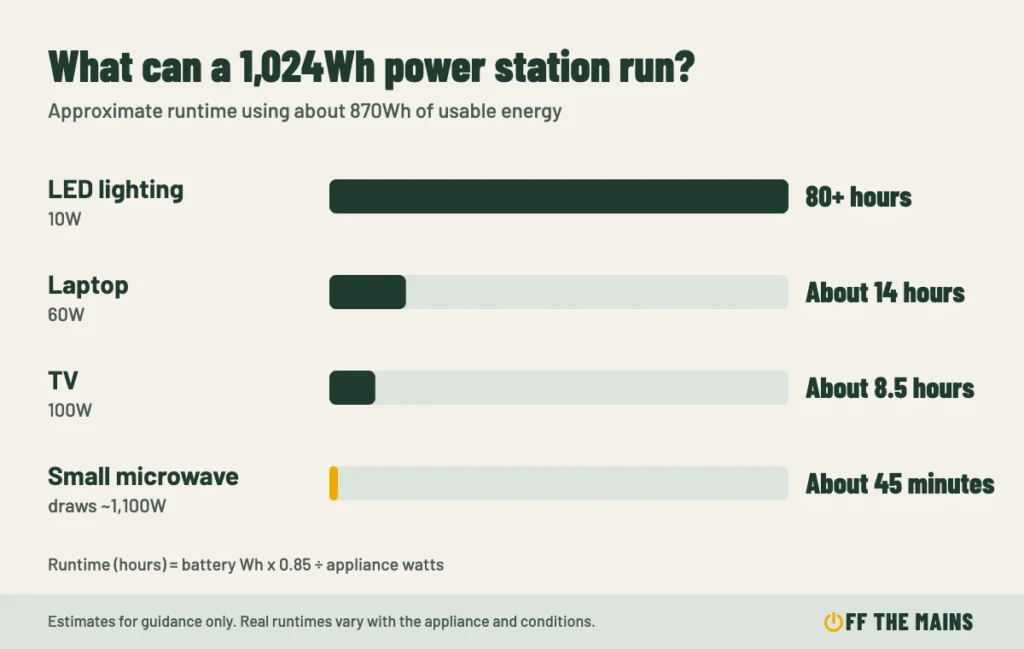
Runtime in hours = battery Wh x 0.85 ÷ appliance watts
The 0.85 allows for energy lost converting the battery’s power to mains power. On a 1,024Wh unit like the DELTA 3 Plus, that gives you about 870Wh to use:
- A 60W laptop: about 14 hours
- A 100W TV: about 8.5 hours
- 10W of LED lighting: over 80 hours
- A small 700W microwave, which pulls around 1,100W from the socket: roughly 45 minutes of cooking
2. Check the output against your appliances
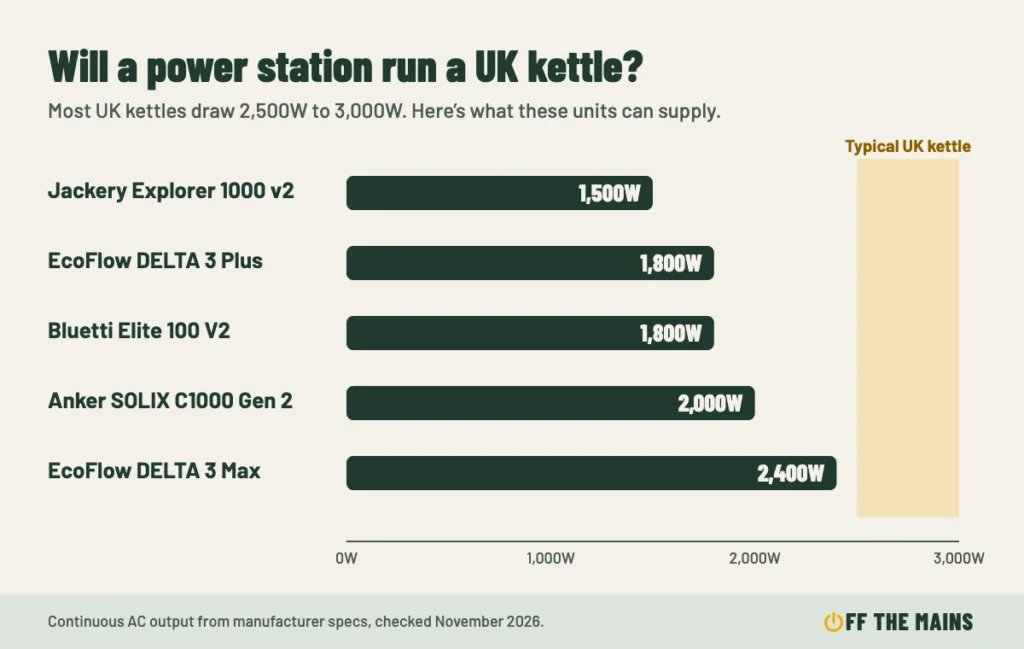
Output (W) is how much the unit can supply at once. This is where UK buyers get caught out: most UK kettles are 2,500W to 3,000W, so a 1,800W power station won’t run one. The same goes for most fan heaters and hair dryers. Check the wattage on your appliance’s label before you buy.
3. Look for LiFePO4 batteries
LiFePO4 (also called LFP) batteries are more stable and last far longer: typically 3,000 to 4,000+ charge cycles before dropping to 70 to 80% capacity. That’s over ten years of weekly use. Everything on this list uses them.
4. Think about how you’ll recharge it
If you’ll be away from mains power for more than a day or two, solar matters. Check the maximum solar input, and remember UK solar output is much lower in winter. Fast wall charging (under an hour on most units here) matters more if you mostly top up at home.
5. Want backup during power cuts? Check the UPS speed
A UPS function means devices plugged into the unit keep running when the mains drops. A 10ms switchover is fast enough for most computers and routers; 20ms suits most other kit.
Frequently asked questions
Can a portable power station run a kettle?
Usually not. Most UK kettles draw 2,500W to 3,000W, more than the 1,500W to 2,400W these units supply. A low-wattage travel kettle (often around 1,000W) is a better bet.
Are portable power stations safe to use indoors?
Yes. Unlike petrol generators, they produce no fumes or exhaust, so you can use them in a garden office, van or living room. Keep them ventilated, dry and away from heat.
How long does a portable power station last?
The units here are rated for 3,000 to 4,000+ full charge cycles. Even charged every day, that’s around ten years before the battery drops to 70 to 80% of its original capacity.
Do I need solar panels?
Only if you’ll be away from mains power for long periods. For power cuts or weekends away, charging from the wall before you go is often enough.
Which size should I buy?
Around 250Wh suits phones, laptops and lights. 1,000Wh is the sweet spot for garden offices, camping and short power cuts. Choose 2,000Wh or more for running bigger appliances or covering longer outages.